
Sunday, February 15, 2026
The Global Proliferation of QR Code Technology: 2026 Industry Report on Cross-Sector Applications
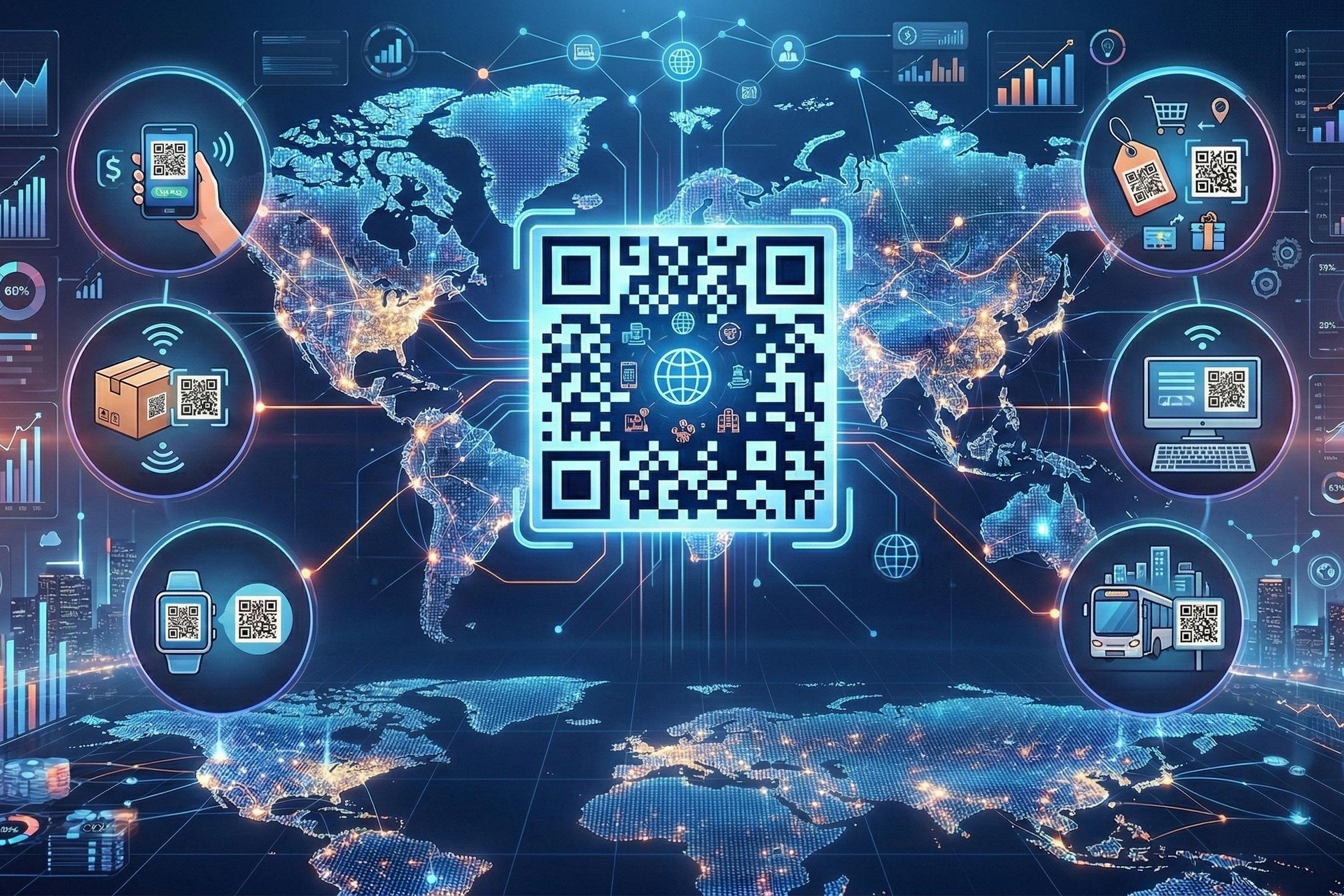
Originally engineered in 1994 by Masahiro Hara of Denso Wave to track automotive components, the Quick Response (QR) code has undergone a fundamental transformation. Once a niche industrial tool, it is now the primary interface for the "Internet of Packaging" and global digital infrastructure. As of 2026, the global QR code market has reached a valuation of $15.23 billion, driven by an estimated 102.6 million regular smartphone scanners in the United States alone.
1. Industrial Evolution: Commercial Tracking and Warehouse Stock Control
In the logistics and maintenance sectors, QR codes have largely superseded 1D barcodes due to their high data density and superior damage resistance—remaining readable even when up to 30% of the symbol is obscured.
Inventory Intelligence and Accuracy
Modern warehouse management systems (WMS) now integrate QR scanning with Computerized Maintenance Management Systems (CMMS). Research indicates that transitioning from manual or spreadsheet-based tracking to QR-driven workflows can increase inventory accuracy from a baseline of 58% to over 97% within 90 days.
- Real-Time Traceability: QR codes allow for granular tracking of batch numbers, lot codes, and expiration dates for perishable goods.
- Operational Efficiency: Automated "cycle counting" using mobile QR scanners has reduced the labor hours required for annual inventory shutdowns by approximately 68% in major logistics hubs.
2. Transit and Entertainment: The Rise of "Scan-and-Go" Infrastructure
The global smart ticketing market is projected to reach $25.33 billion by the end of 2026, with QR technology serving as the primary delivery mechanism for secure, contactless entry.
Public Transport Integration
National rail networks, such as Deutsche Bahn (DB) and Austrian Federal Railways (ÖBB), have successfully digitized 100% of their ticketing operations using unique QR identifiers.
- The QRIS Standard: In Southeast Asia, the Quick Response Code Indonesian Standard (QRIS) has unified fragmented payment systems, enabling over 43 million users to board public transit and make P2M (person-to-merchant) payments via a single interoperable code.
- Hygienic Boarding: Post-pandemic, 72% of transit passengers prefer QR-based boarding to avoid physical contact with kiosks and currency.
High-Volume Event Management
For the entertainment sector, dynamic QR codes, which can refresh their data payload at set intervals, have become the standard for preventing ticket fraud and unauthorized duplication at stadiums and music festivals.
3. Product Marketing and Loyalty: Bridging Physical and Digital Worlds
Marketing with QR codes has moved from experimental to foundational. Over 90% of marketers now incorporate QR codes into their multi-channel campaigns.
Measurable ROI and Engagement
By appending UTM parameters to dynamic QR codes, brands can now attribute offline traffic (from billboards or print ads) with digital-level precision.
- Engagement Lift: Campaigns utilizing QR-initiated journeys report average click-through rates (CTR) of 37%, compared to the 2–5% typical of standard display advertising.
- Frictionless Loyalty: Global retailers like Starbucks and Sephora utilize QR codes to facilitate instant loyalty program sign-ups. Research shows that 72% of consumers prefer scanning a code to earn points over downloading a dedicated mobile app.
4. In-Store Product Labeling: The GS1 Digital Link Revolution
The most significant shift in retail history is the "Sunrise 2027" initiative—the global transition from the traditional UPC barcode to 2D codes powered by the GS1 Digital Link standard.
The Single-Scan Paradigm
Historically, products required multiple codes: a UPC for the checkout and a QR code for marketing. The GS1 Digital Link consolidates these into a single module.
- Consumer Transparency: Scanning a GS1 Digital Link can reveal a product's entire manufacturing history, sustainability credentials (e.g., the EU's Digital Product Passport), and real-time recall status.
- Pharma Traceability: Over 45 countries now mandate QR-based serialization on prescription drug packaging to combat the counterfeit trade, which accounts for over 10% of global pharmaceutical sales.
5. Future Outlook: AI, Sustainability, and Identity
By 2027, QR codes will be deeply integrated with artificial intelligence to provide personalized consumer experiences. 84% of marketers plan to integrate AI with QR-driven data to predict and personalize customer rewards. Furthermore, the sustainability impact is significant; large scale QR adoption is estimated to save millions of paper tickets and labels annually, aligning with global climate goals.
Conclusion: A Paradigm Shift in Universal Connectivity
The image of the "QR code" article snippet highlights a critical historical pivot: the transition from a niche automotive tracking tool to a ubiquitous global utility. As of 2026, the technology has successfully resolved its most significant hurdles standardization and consumer adoption. The five pillars identified in the research: commercial tracking, warehouse stock control, entertainment and transport ticketing, product and loyalty marketing, and in-store product labeling—now form the backbone of a $15.23 billion industry.
While the original purpose of the QR code was to optimize the Japanese factory floor, its modern legacy is defined by its role as the primary bridge between the physical and digital worlds. With over 100 million Americans scanning codes weekly and the upcoming "Sunrise 2027" mandate for 2D barcodes at checkout, the technology has reached near-saturation and evolved into a mandatory standard for global commerce and identity management. The transition from static hardlinks to AI integrated dynamic ecosystems ensures that QR codes will remain the dominant interface for the Internet of Things for the foreseeable future.